
Climate literacy and green skills were explained to young people at MAKÜ
Yapılış Tarihi | 02 October 2026, Friday

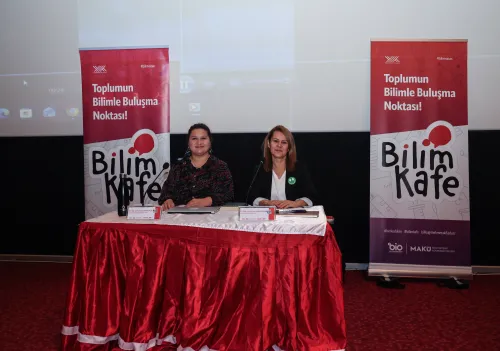
The Science Café Meetings organized by the MAKÜ Science Communication Coordination continued with the program 'Climate Literacy and Green Skills for Young People'. The event held at Avşarhan Cinema Hall discussed the awareness of young people regarding climate change and the development of sustainable habits in daily life.
In the program, Sustainability Coordinator Dr. Faculty Member Kübra Ertan Türe and Dr. Faculty Member Esra Çakar Özkan participated as speakers.
The importance of individual steps in the climate crisis
Dr. Faculty Member Kübra Ertan Türe, who gave the first presentation at the event, provided information about the historical development of the concept of sustainability, the COP31 process, and the fundamental elements of climate literacy. Türe drew attention to the role that young people can take in combating climate change and explained the effects of daily life choices on the environment through carbon footprints.
Addressing the impact of energy use, transportation preferences, consumption habits, and waste management on greenhouse gas emissions, Türe illustrated the importance of measures that can be taken on an individual scale in reducing the effects of the climate crisis with examples.
Attention was drawn to 'hidden water' consumption
In the second part of the program, Dr. Faculty Member Esra Çakar Özkan informed participants about the sustainability of water resources and water footprints.
Pointing out that the threat of water scarcity is growing, Çakar Özkan stated that water consumption is not limited to the water used from the tap, highlighting the amount of water consumed in the production processes of products used in daily life.
Çakar Özkan conveyed that the water used in the production of many products, from clothing to food, is referred to as 'hidden water consumption', and explained the effects of agricultural and industrial production on water resources with examples. She emphasized that young people could contribute to sustainability through water conservation, conscious consumption, and environmentally friendly choices.
High participation from young people
In the program, which continued with question-and-answer sections and interactive sharing, young people directed their questions about climate change and sustainable living to academics.
It was emphasized that the climate crisis is a subject that needs to be addressed not only with decisions to be made on a global scale but also with conscious choices that individuals will make in their daily lives.
The Science Café Meeting concluded with raising awareness for young people to develop environmental consciousness, increase their climate literacy, and acquire the green skills needed for the future.