
MAKÜ provides renewable energy support to combat drought in Africa
In a European Union-supported project, solar energy will be combined with agriculture. The study aims to contribute to the fight against drought and desertification in Africa, planning to grow medicinal and aromatic plants, especially thyme, under solar panels.
Date | 26 November 2026, Thursday

Burdur Mehmet Akif Ersoy University (MAKÜ) aims to develop solutions to the problems of drought and desertification in Africa with an international project that combines renewable energy and agricultural production. In the LEAP-SEED project supported by the European Union's Horizon Europe program, it is aimed to make agricultural production sustainable in arid regions by utilizing solar energy.
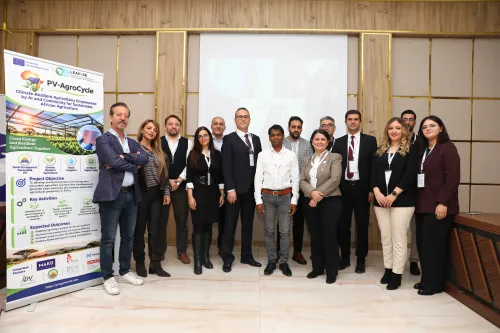
Assoc. Prof. Dr. Gökhan Yılmaz from the Department of Energy Systems Engineering at MAKÜ Faculty of Engineering-Architecture provided information about the project during a meeting. The meeting, attended by project partners from other countries via Zoom, was held both face-to-face and online.
Agricultural production under solar panels
The project, which includes a total of seven partners from Germany, Turkey, Algeria, and Morocco, plans to carry out agricultural activities under semi-permeable solar panels. Thus, it is aimed to achieve solar energy production and agricultural production in the same area.
With the sensor networks to be established within the project, the system will be continuously monitored and controlled autonomously. Digital twins of the system will be created using artificial intelligence-supported models and data analytics methods. While studies are being conducted to ensure that plants can continue to grow at night, it is planned to measure the social impacts of the project in its final phase.
Value-added goal with thyme production in Africa
One of the most important goals of the project is to support agricultural production in regions of Africa experiencing drought and desertification problems. In this direction, the focus is on cultivating high value-added medicinal and aromatic plants.
Assoc. Prof. Dr. Gökhan Yılmaz stated that they are particularly working on thyme production and mentioned that there are women cooperatives engaged in thyme cultivation in Algeria and Morocco. Within the project, it is aimed to add commercial value to the products after the production and harvesting activities of the cooperatives.
Yılmaz reported that a model is being developed to enable multiple harvests per year in thyme production, noting that multiple harvest periods could be possible with micro greenhouses to be established on the university campus.
These studies aim to support agricultural production in arid regions, enable local producers to gain economic benefits, and increase the production capacity of women cooperatives.
Field studies will be conducted in Africa within the three-year project
Within the three-year project starting in April 2026, the first products of semi-permeable solar cells are expected to emerge by the end of 2027. While outdoor trials in Africa are planned to start in early 2028, data obtained from the applications will be analyzed during the 2028-2029 period.
The project has a budget of approximately 800,000 euros, with about 6 million TL support for the Turkish part.
Yılmaz stated that Africa was chosen as a special focal point for the project due to its drought and desertification problems, expressing that the developed technology will not be limited to Africa and could be applied in different regions of the world if successful.
The project, which combines renewable energy with agricultural production, aims to contribute to food and energy security in arid regions, support the production of high value-added products like thyme, and create economic opportunities for local producers.